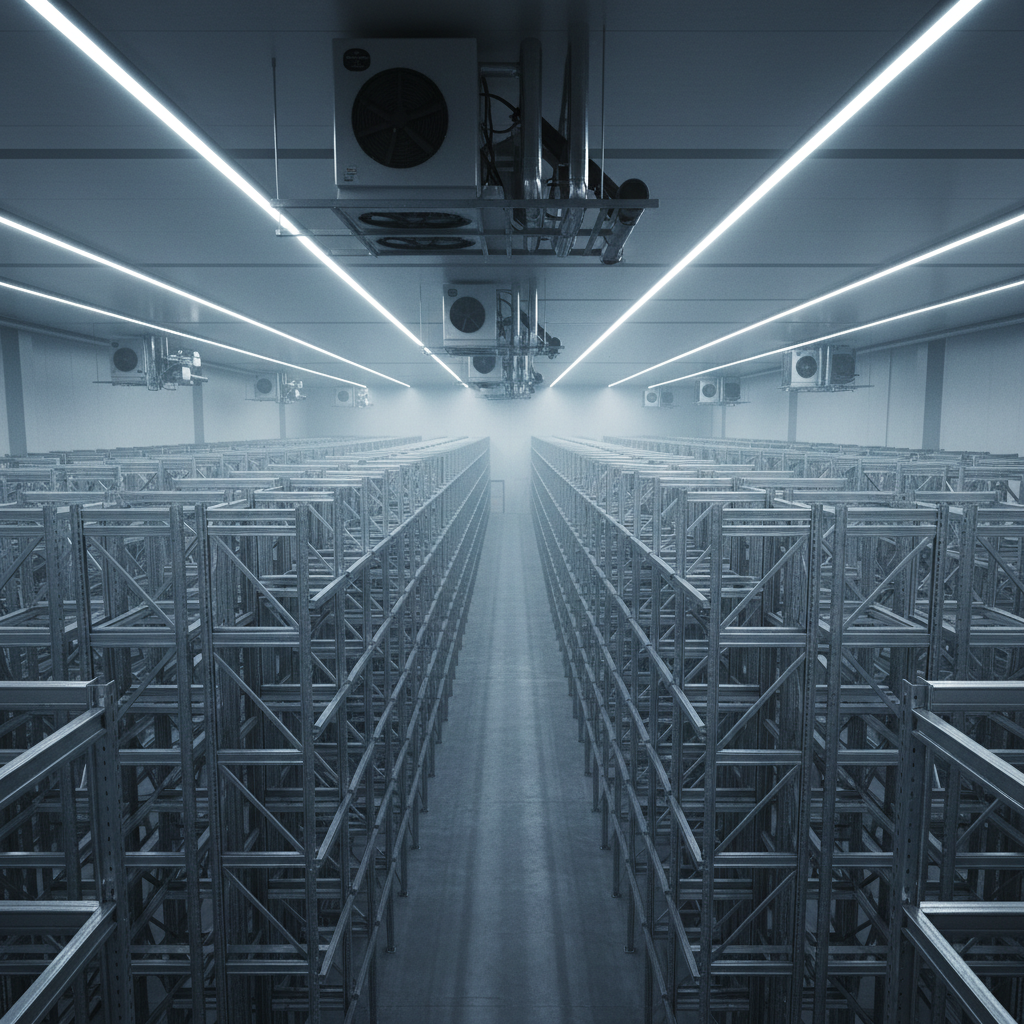
The cold chain logistics sector in Southeast Asia is undergoing a profound transformation, driven by the dual pressures of rising energy costs and increasingly stringent environmental regulations. As the region's demand for temperature-sensitive goods—ranging from fresh produce to pharmaceuticals—continues to surge, the infrastructure supporting this supply chain is being pushed to its limits. For facility managers, engineers, and operators of cold storage warehouses, food processing plants, and ice factories, the challenge is clear: how to maintain precise temperature control while mitigating the escalating financial and environmental costs of refrigeration.
Refrigeration systems are notoriously energy-intensive, often accounting for up to 80 percent of a cold storage facility's total electricity consumption [1]. In tropical climates like Thailand, where the average annual temperature hovers around 28°C and cooling degree days (CDD) exceed 5,100 annually, the energy burden is particularly acute [2]. The traditional approach of relying on legacy freon-based systems is no longer sustainable, both economically and environmentally. This reality has catalyzed a wave of innovation, spearheaded by a growing ecosystem of cold chain startups and established technology providers across the Asia-Pacific region.
These innovators are deploying advanced technologies—from natural refrigerants and phase change materials to predictive analytics and thermal energy storage—to redefine the efficiency benchmarks of industrial cooling. This article examines the technological advancements driving this shift, the regulatory frameworks accelerating adoption, and the measurable impacts these innovations are delivering in real-world applications.
The Regulatory Imperative: Phasing Out Legacy Systems
The transition toward high-efficiency cold chain infrastructure is not merely a response to market economics; it is increasingly mandated by global and regional regulatory frameworks. The most significant of these is the Kigali Amendment to the Montreal Protocol, which mandates an 85 percent reduction in the production and consumption of hydrofluorocarbons (HFCs) by 2036 [3]. This phasedown is projected to prevent up to 0.4°C of global warming by the end of the century, fundamentally altering the landscape of industrial refrigeration.
In the European Union, the recently adopted F-gas Regulation (EU) 2024/573 imposes even stricter timelines, targeting a complete phase-out of HFCs by 2050 [4]. Crucially for global supply chains, this regulation introduces an export ban starting in 2025 for refrigeration, air conditioning, and heat pump (RACHP) systems utilizing refrigerants with a Global Warming Potential (GWP) of 1,000 or higher, provided these systems cannot be placed on the EU market [4]. Furthermore, service bans on virgin refrigerants with a GWP exceeding 2,500 will take effect in 2025 for small systems, with the threshold dropping to 750 by 2032 [4].
These regulatory pressures are accelerating the obsolescence of legacy freon systems and driving the adoption of natural refrigerants, such as ammonia (R717), carbon dioxide (R744), and hydrocarbons. While these alternatives present unique engineering challenges—such as toxicity or high operating pressures—their negligible GWP and superior thermodynamic properties make them the foundation of future-proof cold storage design.
Technological Innovations Redefining Efficiency
The pursuit of energy efficiency in the cold chain extends beyond refrigerant selection. Startups and technology providers are integrating a suite of advanced solutions to optimize every aspect of the cooling cycle.
Advanced Thermal Management and Phase Change Materials
One of the most promising developments in cold storage efficiency is the application of Phase Change Materials (PCMs). PCMs absorb and release thermal energy during the process of melting and freezing, effectively acting as a thermal battery. By integrating PCMs into the building envelope or directly into the refrigeration system, facilities can decouple cooling demand from electricity consumption.
A 2024 study analyzing the implementation of PCM-based cold storage in a technology facility in Taiwan demonstrated the profound impact of this approach. The system was designed to charge the PCMs during nighttime off-peak hours—when ambient temperatures and electricity tariffs are lower—and discharge the stored cooling capacity during daytime peak hours [5]. The results were substantial: the facility achieved a 32 percent reduction in electricity costs and an 18 percent decrease in overall energy consumption, amounting to 118,411 kWh saved annually [5]. The dynamic payback period for this investment was calculated at just 1.8 to 2.9 years, yielding an Internal Rate of Return (IRR) between 39.8 and 56.5 percent [5].
Intelligent Controls and Predictive Analytics
The integration of Internet of Things (IoT) sensors and proprietary Building Management Systems (BMS) is transforming cold storage facilities from static environments into dynamic, responsive ecosystems. Modern BMS platforms utilize digital twin modeling and machine learning algorithms to continuously monitor and adjust system parameters in real time.
By deploying variable frequency drives (VFDs) on all major equipment—including compressors, pumps, condenser fans, and evaporator fans—these systems can precisely match cooling output to the actual thermal load. This eliminates the inefficient "stop-start" cycling characteristic of legacy systems. In a recent case study from the United States, a facility utilizing a proprietary low-charge ammonia system paired with an advanced BMS achieved a 62 percent reduction in electricity usage compared to legacy freon systems, and a 30 percent improvement over modern standard ammonia designs [1].
High-Performance Insulation
The efficacy of any refrigeration system is fundamentally limited by the thermal integrity of the building envelope. Traditional polyurethane foamed-in-place panels degrade over time, absorbing moisture and losing thermal resistance. Innovators are increasingly turning to next-generation materials, such as extruded polystyrene (XPS) and vacuum insulated panels (VIPs). VIPs, in particular, offer five to ten times the thermal efficiency of conventional materials, drastically reducing the thermal load on the refrigeration plant and extending compressor lifespan [6].
Real-World Applications and Measurable Outcomes
The theoretical benefits of these innovations are being validated through commercial deployments across the Asia-Pacific region and beyond.
In Japan, Maruha Nichiro Logistics undertook a comprehensive initiative to phase out CFCs and upgrade its cold storage infrastructure. At its Kawasaki Logistics Center 1, the company installed a state-of-the-art natural refrigerant system. The implementation resulted in a 17.8 percent reduction in overall facility electricity consumption, with individual refrigeration units achieving efficiency gains of approximately 20 percent [7]. The system's remote monitoring capabilities also streamlined maintenance operations, reducing the need for on-site specialized technicians [7].
Similarly, Benirei Logistics retrofitted its 40-year-old, R22-based cold storage warehouse in Osaka. Facing a humid subtropical climate and a corrosive coastal environment, the facility deployed a transcritical CO₂ compressor rack paired with V-shape compact gas coolers featuring adiabatic pre-cooling technology [8]. The adiabatic system pre-cools the inlet air before it reaches the heat exchanger, significantly lowering the condensing temperature and enhancing energy efficiency, particularly during the hot summer months [8]. To combat the harsh marine environment, the heat exchangers were treated with an electrophoretic dip coating (KTL), ensuring long-term durability [8].
The Thai Market Context: Incentives and Economics
For operators in Thailand, the economic rationale for upgrading cold chain infrastructure is strengthening. The Electricity Generating Authority of Thailand (EGAT) utilizes Time-of-Use (TOU) tariffs, which present a significant opportunity for facilities capable of shifting their energy loads. By leveraging thermal energy storage technologies, such as PCMs or advanced subcooling systems, operators can run compressors during off-peak hours (typically 10:00 PM to 9:00 AM) and coast through peak demand periods, drastically reducing operational expenditures.
Furthermore, the Thai government is actively incentivizing the adoption of energy-efficient technologies. The Board of Investment (BOI) has introduced comprehensive measures for the 2026-2027 period, offering import duty exemptions on energy efficiency machinery and a three-year Corporate Income Tax (CIT) exemption on revenue derived from efficiency projects [9]. These incentives, combined with the stringent energy management reporting requirements enforced by the Department of Alternative Energy Development and Efficiency (DEDE) for large industrial users, create a highly favorable environment for capital investment in advanced refrigeration systems.
Conclusion
The future of cold chain logistics in Southeast Asia will be defined by the intersection of sustainability and advanced engineering. As regulatory pressures mount and energy costs remain volatile, the reliance on inefficient, high-GWP refrigeration systems is no longer a viable business strategy. The innovations emerging from the startup ecosystem and established technology providers—encompassing natural refrigerants, thermal energy storage, and intelligent controls—offer a proven pathway to operational resilience.
For decision-makers in cooling-intensive industries, the data is unequivocal: investing in high-efficiency infrastructure is not merely an environmental compliance exercise; it is a strategic imperative that delivers measurable reductions in total cost of ownership and secures long-term competitive advantage.
References
[1] Cold Summit. (2025). Cold Summit Delivers Industry-Leading Energy Efficiency in Cold Storage Design. Retrieved from https://coldsummit.com/case-study/cold-summit-delivers-industry-leading-energy-efficiency-in-cold-storage-design/
[2] World Bank Group. (n.d.). Climate Change Knowledge Portal: Thailand - Climatology (CRU). Retrieved from https://climateknowledgeportal.worldbank.org/country/thailand/climate-data-historical
[3] Harvard Law School Environmental & Energy Law Program. (2025). Hydrofluorocarbons and the Kigali Amendment to the Montreal Protocol. Retrieved from https://eelp.law.harvard.edu/tracker/hydrofluorocarbons-and-kigali-amendment-to-montreal-protocol/
[4] Danfoss. (n.d.). F-Gas Regulation - HFC phase-down - Timeline. Retrieved from https://www.danfoss.com/en/about-danfoss/our-businesses/cooling/refrigerants-and-energy-efficiency/hfc-phase-down/danfoss-on-f-gas-regulation/
[5] Peng, S.-H., & Lo, S.-L. (2024). An Economic Analysis of Energy Saving and Carbon Mitigation by the Use of Phase Change Materials for Cool Energy Storage for an Air Conditioning System—A Case Study. Energies, 17(4), 912. https://doi.org/10.3390/en17040912
[6] Alonso, G. C. (2025). The Future of Cold Storage: Innovations in Energy Efficiency. HVAC Insider. Retrieved from https://hvacinsider.com/the-future-of-cold-storage-innovations-in-energy-efficiency/
[7] MAYEKAWA Global. (n.d.). Case study | NewTon: Maruha Nichiro Logistics, Inc. Kawasaki Logistics Center 1. Retrieved from https://mayekawa.com/lp/newton/casestudy/04.html
[8] Güntner. (n.d.). Cold Storage Warehouse, Japan. Retrieved from https://guntner.com/en-us/our-impact/case-studies/cold-storage-warehouse-japan
[9] Alvarez & Marsal. (n.d.). Thailand's Renewed BOI Incentives: A Strategic Window for Growth, Expansion, and Investment (2026-2027).